Thursday, October 22, 2015

Pentecost 22 (Proper 25)
Year B
Psalm 126


When the LORD restored the fortunes of Zion,
then were we like those who dream

What would such a restoration of our fortunes look like? An individual winning the Euro-Millions Lottery or a like-minded community witnessing their political party restored to power? The restoration of God's people would have what sort of substance, exactly? For the people of Israel in exile in Babylon restoration meant something quite palpable - a return for them and their children to
their historic lands, the restoration of faithful Jewish worship and a safe existence behind their own walls with political and religious leaders of their own choosing. They could have written you a list - items A to F - nothing mysterious there.

The New Testament, as you know, makes no promise of land. The land as the cardinal possession of God's people pretty well disappears in the Gospels and Epistles. Christ's followers are to be sent into the whole world and are to be at home wherever the Spirit of God sends them. Jesus doesn't put a lot of stock in safety, either, or in political strength and stability. Preserving one's life, he says, can be the route to the ultimate loss of one's soul. No gain there, then. Knock these off the list. Are we left only with intangibles; an invisible sense of personal fulfillment or an inner verdict that "things aren't so bad after all"? It's a safe position. Nobody could prove us wrong (don't we all feel good sometimes?) but the promises of the Kingdom of God here are short-changed. Jesus says the Kingdom is "around us" or "within us" or "among us" but he does not say that it lacks substance or evidence. It can actually be found like a treasure in a field, or like a pearl of great price or a lost coin recovered after the homemaker's mad scramble with a broom. It is a thing and not merely a sentiment.  You should be able to tell whether you're part of it or not, or at least whether you're on the right path.

So where do we start?

Jesus' words and actions point to the substance of the Kingdom. Through parables and pronouncements, healings, miracles and the lifting up of wine and broken bread, Jesus shows us what the Kingdom looks like:
  • The removal of shame and the restoration of strangers and outcast people to community.
  • The vindication of God's historic promises to humanity - that these proved true and were no lie.
  • The discovery of purpose and direction by both individuals and communities.
  • The presence of courage, perseverance, kindness and commitment as the fruits of the community's faith and repentance.
  • A willingness to follow the Spirit where it leads and the presence of that same Spirit in the heart of the community's worship.
Can this substance be found in your church, your home or your life? Give thanks if it is. If not (or if not enough) then let this first verse of Psalm 126 be for you a statement of your longing.

Write yourself a list.


Monday, October 19, 2015

Pentecost 21 (Proper 24)
Year B
Job 38:1-7

Then the LORD answered Job out of the whirlwind: 'Who is this that darkens counsel by words without knowledge? ........Where were you when I laid the foundation of the earth? Tell me, if you have understanding.'

Have you ever been talked to from the midst of a whirlwind?

Imagine you are having an important conversation with somebody on the telephone. In the background you hear the tapping of a keyboard. The person you're talking to is clearly multitasking.

This bothers you.

You are dragged along the hallway by a superior between his two o'clock meeting and his two-fifteen as he tries and deal with the question you've asked him in the space of fifty yards of badly carpeted corridor. You feel cheated and undervalued. This is true. You are.

Were you to complain he might say something like "Sorry I have a life that doesn't have only to do with you. Where you you when this project went south and the investors demanded a meeting? Where were you when the deadline got changed and it was suddenly 'all hands on deck?'"

You're right. Your complaint, question or issue is not getting the time it deserves.

But then again, he is right too. The world is a big place. It contains more than just you.

Does any of this apply to poor Job in his complaint to God about a missing family, the boils on his body and his many other misfortunes? Well, frankly, no. The analogy is a poor one, were it not for the fact that the people I know who have completely valid complaints (the cancer has returned, the job has worked out badly, the kid has been caught smoking dope, the divorce papers have arrived at the hand of a burly and unpleasant bailiff) these folks do, nonetheless invariably stop paying attention to the world beyond the awful one they live in.

Can they articulate their complaint clearly? Yes, of course they can. Is it a palpable reality? Most probably, yes. Dreadful things fall on people from a height. Awful things hit the fan. Pitfalls abound..  Nonetheless...the greatest injury done to grieving people, to people besieged by troubles or stresses, is that their world shrinks to a point. And, as difficult as it might be for any such a person to conceive of being pushed beyond the circle of grief and dis-ease in which he takes his place, it is precisely that to which God points us out of the whirlwind - the great big world around us where God is stirring the pot.

Praise him.
Praise God for "...his excellent greatness."

He brings to us, in our grief, the world - big and beautiful and turbulent and above all - still and always - the dwelling place of God.


Thursday, October 08, 2015

Pentecost 20 (Proper 23)
Year B
Mark 10:17-31    


…he was shocked and went away grieving, for he had many possessions… Jesus said…”It is easier for a camel to go through the eye of a needle than for someone who is rich to enter the kingdom of God”

Fine. Here he is having another go at us. What’s this all about then - rich men and camels and the eyes of needles? One more reason to squirm at the back of church on Sunday. You wouldn’t be alone.
Any focus group gathered together to discuss the passage would think that they were being criticized for having possessions or for being born in the most prosperous hemisphere of the earth when so many other people in the world make do with less. Whatever… That same group of respondents, however, when fed a different saying of Jesus – let’s say, for example:

“Come unto me all you who are heavy laden and I will give you rest”

wouldn’t bat an eyelash. This is good! This is Jesus promising something to us rather than criticizing us. Burdens are bad and if Jesus wants to divest us of those burdens then we should say yes. You’ve figured out where I’m going with this: It amounts to the same thing.

In the larger story of this Sunday’s Gospel reading a young man who is pious and eager asks Jesus what he must do to inherit eternal life. After having checked the boxes of both eagerness and piety, Jesus tells him that he needs to free himself up to be a follower – and that the discipline of the Kingdom is not a party membership badge which one adds to an already completed wardrobe.

Those who follow are those who are free to follow. Many of us are burdened. Some carry the burdens that others put upon them. The mission of the Church (as it was the mission of Jesus) is not only to reassure such folks that they may be free but, through both evangelism and activism, to free the oppressed in Jesus’ name. We do something in word and act which defies the necessity of such burdens on others. Let my people go! 

Some carry their own burdens. With an eye to safety and security they make themselves prisoners. In the name of financial stability they make it nigh on impossible to say yes to anything which is “off message” or “off the beaten path”. Why have we become our own worst enemies? Do remember that repentance, generosity and service to others are acts of defiance. They defy the tendency to self-preoccupation which keeps us bound, which denies us our liberty to follow, to change and transform – to say “yes” to the big and beautiful things which come our way. Look at yourselves the way you look at another who has been unjustly burdened or enslaved.

With compassion and tenderness you might say of yourself-as-another“What can I do to set that man or woman free?”


Thursday, October 01, 2015

Proper 22 - Year B
Pentecost 19
Mark 10:2-16


“Whoever divorces his wife and marries another commits adultery against her and if she divorces her husband and marries another, she commits adultery.”

Image result for jesus preachingI wish he hadn’t said that. Not that way. If Jesus is this matter-of-fact on the subject where does he leave my parishioners who don’t fit the mould? For that matter where does he leave their parish priest - himself a divorced and remarried man? This came up online with my pals during the week: “What are y’all doing with the unequivocal words of Jesus about divorce and remarriage in your congregations this Sunday?" Suggestion number one from Nigel – “Preach on something else. Psalm 8 perhaps”. It’s what a former Archbishop of Canterbury did a few years back on this particular Sunday, effectively dodging the bullet. Suggestion number two from Kenny – “Nah Rob; be a Scotsman and wade right in”.

“Okay, fab, Kenny! You’re a pukka Scotsman. Is that what you’re doing?”

“No, we’ve got Harvest Thanksgiving this Sunday. Different readings, the church decorated with squash and bulrushes – ‘We Plough the Fields and Scatter’ and all that jazz.”

Which leaves me alone, therefore, with a Gospel reading in which I am quite explicitly named as a malefactor - as are a selection of you reading this. We resemble that remark. It does no justice to the Scripture to imply that Jesus is doing anything other than underlining the sinful state of humanity: our humanity in general - yours or mine in particular this Sunday. If there’s to be a “Yes, but…” anywhere in the sermon let it come at the end rather at the beginning. Well-aimed arrows of judgement should not simply be batted aside at the outset. It wouldn’t be right. It wouldn’t be true. The death of our relationships speaks volumes about our weakness and our sin. Eh, voila! There we are - standing on sinners’ corner.

Sinners’ corner is the place where we belong – all of us. It will do no good to traipse up to Jesus, as some did during his earthly ministry, to say “You didn’t specifically name me, did you Jesus? I’ve kept the rules since my youth, haven’t I?” As will be explained to any who hold such misconceptions about being off the hook; the commandment against murder can be extended to anger and the commandment against adultery even to our fleeting lusts. Those who can remember the day and the year when everything came tumbling down – those who find they’ve been named in the 10th chapter of Mark – may here be the lucky ones. You never know. Don’t count yourselves too quickly amongst the sheep. Don’t assume that you’re the only goat in the room. It took the disciples far too long to arrive at the place where they could finally exclaim “Who, then, Lord can be saved?”

They would come to understand: This was not the end of the line. It was only the starting point


Thursday, September 17, 2015

Proper 20 - Year B
Pentecost 17
Proverbs 31:10-31


A capable wife who can find? She is far more precious than jewels......

The jury is still out on whether or not I will risk wading into the 31st chapter of the Book of Proverbs in my sermon this Sunday - the reading which takes as its subject: "A Capable Wife" or in slightly grander language "A Wife of Noble Virtue".  Is my skin thick enough and are my shoulders sufficiently broad to take the repercussions of somebody thinking that I got it wrong?

I want to preface these remarks by stating at the outset that I am married to a Wife of Noble Virtue, was raised by one back in British Columbia and that my daughter in Montreal seems well on the road to taking her place in such a designation within her generation.  Women of Noble Virtue loom large in my extended family and many of them were, in fact, married.  That primary relationship and the household which came with it formed part of the springboard from which their nobility and the virtue could flow effectively in their day and age.

One chief objection to the first reading this Sunday from Proverbs is that the "capable" or "virtuous" wife being described here seems to work her fingers to the bone.  She is in the house, around the house, supervising servants, steering the children forward, haggling with merchants, spinning and weaving, caring for the poor and, above all, being the engine of economic and moral activity in her family.  Her husband seems to spend his time at the city gates with his friends.  No other sphere of activity is specifically credited to him.

There's quite a lot in the Book of Proverbs about wives.  Not all of the reflections there are particularly illuminating or helpful and we tend to move from those negative appraisals of women to then tumble upon this reading about a woman who seemingly has the labours of the world piled upon her back.  This reading suffers badly from the comments and opinions of folks who haven't read it through on its own merits.  Read it, will you?  The woman described herein is a beacon to her village or town.  She is a moral and economic giant within her family and her local community.  She is a force to be reckoned with.

We are blessed at Christ Church with a full complement of high school girls.  While they may not choose to live their lives in the shadow and pattern of the woman described in this Sunday's Old Testament Lesson they will, I hope, think kindly of a woman who seizes the challenges of her day with an iron grip and made things happen.

Girls of Christ Church - take note.

If there's anything to be improved upon or departed from in this passage about the Wife of Noble Virtue it might be in the woman's choice of a husband.   We look in vain for any evidence of his substantial contribution to his age and generation.

Boys of Christ Church - take note.


Saturday, September 12, 2015

Pentecost 16 (proper 19)
Year B
Proverbs 1:20-33


How long, O simple ones, will you love being simple? How long will scoffers delight in their scoffing and fools hate knowledge? Give heed to my reproof.

If you've played Tile Rummy or other numbers games with teenagers or young adults - any game, in fact, which requires quick thinking and mental acuity - you'll be struck by how clever these young people are. They do calculations quickly. They see patterns of numbers with little effort. You'd have gotten there yourself - eventually - but you might feel as if you're toting your brain uphill like a heavy load. No question about it: These kids are smart! Time to start taking your vitamin E!

They may not yet be wise, though. In fact you know that they're not. This very same person whose brain is so adept at figuring out a limited set of tasks still lacks judgement, does not yet understand the paradoxes which abound in real life and cannot yet work in an able fashion within communities. Those of you who have supervised younger employees in companies, young doctors and nurses in
hospitals will recognize that situation where you stand there looking at somebody who has so much raw potential and yet is still not ready for certain responsibilities which require a sort of "smarts" which can only be given by deep reflection, by an experience of both success and failure and by a breadth of knowledge which raw organic intelligence itself does not give.

Our passage from the Book of Proverbs this Sunday speaks of a different impediment to wisdom - not merely "youth" which in most cases will give way to richer ways of being intelligent. In our passage on Sunday, Wisdom - a feminine characterization of God in this case - cries out to those who have chosen ignorance rather than wisdom. They love being simple. They delight in scoffing. They hate knowledge. The target of Wisdom's 'reproof' is a community of possibly quite grown-up people who decided not to embark on learning much about the world. They cooped themselves up in a small world. They may be critics - scoffers - who see the faults in others and who are adept at picking apart structures around them which do not meet their immediate needs but have yet to make their own costly contribution. Knowledge - new reflections on life in the world - is a threat to what they were taught. Coming to risk knowing something new gives us cause to reevaluate ourselves, to rethink the values of our home communities, to transform and to become wise.

On occasion we shame ourselves. Why did I say that? Why did I do that? Why was I speaking rather than listening? Was I the friend I could have been? Did I miss an opportunity? This Sunday's lesson gives us space to identify, and even mock, that part of each of us which refuses to grow up and be wise - to venture outside comfortable simplicity and to be bigger than we have allowed ourselves to be.


Friday, September 04, 2015

Proper 18 - Year B

Pentecost 15
Mark 7:24-37

Jesus is clear that his mission is first of all to the "...lost sheep of the house of Israel". The lapsed
and neglected Jews of Roman Palestine were the first recipients of his message. It is to their towns and hamlets which Jesus and his disciples first traveled with the message of God's closeness and the presence of his Kingdom. The Gospels don't draw the line there. Jesus' parables hint warmly of an expanded and much more inclusive Mission - one which will ultimately include the Gentile tribes and nations from which most of our families spring. The starting point, however, seemed much narrower. The lost sheep got the first crack at Jesus and his disciples.

"Me too - I want in", says a Syrophoenician woman to Jesus in this Sunday's Gospel reading. "Surely there's enough leftover grace - crumbs even -  for my daughter and myself. We want to have some of it too."

And so this unnamed Canaanite woman joins a collection of characters in the New Testament - gutsy and opportunistic - who, by hook or by crook, present themselves at the head of the queue - who yell out or push or squeeze their way into the light and are rewarded rather than rebuffed. Their expression of need is raw and strong and honest.  They will do what it takes to present themselves before the source of their wholeness - their healing - their restoration.   Some of them are real people who Jesus encountered in the course of his ministry. He praises their aggressive approach as an example of great faith. Others are characters in his parables - admirable characters who we are to emulate.. The woman in this week's reading joins with the persistent widow (Lk 18:1-8), Zaccheus in his tree (Lk 19:1-10), the unrighteous steward (Lk 16:1-13), blind Bartimaeus by the side of the road (Mk 10:46-52) as well as the anonymous woman with her jar of ointment who crashed a dinner party Jesus was attending (Lk 7:36-50). 

They demonstrate, for our benefit, the power of sheer bloody-mindedness.

Do you want in? You might want to reset your compass. Accepting one's lot in life, putting on a pleasant face in the midst of terrible troubles, keeping one's problems to one's self, waiting to be invited rather than just showing up - these are polite manners of life for people in gated communities or people in cold northern climes who distrust their neighbors - Viking etiquette maybe but no Kingdom virtue. Jesus, on the other hand, tells us to ask in order that we may receive. He says that for the door to be opened to us we first need to knock

 He doesn't even seem particularly dismayed by the thought of our doing so with a very large stone.


Friday, July 24, 2015

The Ninth Sunday after Pentecost
Proper 12 -Year B
Ephesians 3:14-21


The writer of Ephesians is above all a pastor. As such he has tangible dreams for his flockHe puts these hopes and imaginings forward in the form of two prayers for quite specific things:

Firstly, that the Christians at Ephesus might be strong within themselves

"..and that Christ may dwell in [their] hearts through faith, as [they] are being rooted and grounded in love." 

He prays as well that they 

"...may have the power to comprehend, with all the saints, what is the breadth and length and height and depth, and to know the love of Christ that surpasses knowledge, so that [they] may be filled with all the fullness of God."

Pay some attention to these words, please. Do they sound a tad general? Are they, for you, the sort of religious language that sometimes washes over you without sinking in? The indwelling of Christ in a believer and the slow transformation (being rooted and grounded) of his or her life through the power of love was and remains an actual experience in the lives of Christians. Associates, family
members, former friends and enemies recognized in the lives of those whom Christ had seized that these people were being changed and were no longer who they once were. This change then led to understanding (the power to comprehend) how these inner changes were in fact consonant with what God was doing in the world and in the lives of others; there was both evidence within the believer and evidence without.

While the writer prays for specific things - the indwelling Spirit of God and growth in understanding- he finishes this small section by appealing to what he cannot possibly know or, more importantly, control: he consigns his flock to the love and care of God who 

"...by the power at work within us is able to accomplish abundantly far more than all we can ask or imagine".

What all pastors know is that the Word goes out and is received by the senses and the emotions. It mingles with the competing loyalties and the lifestyles of the hearers. It is at once seized on and yet kept at arm's length for a time. People mull it over. It troubles them as much as it thrills them. What do pastors do? Pastors pray. They pray that God will do his work in the hearts of those to whom the Gospel has been presented. God is the gardener, after all - the one who brings in the harvest.

He is the master of the mystery of what happens when folks go home - after the sermon has been preached, the hymns sung and bread and wine have been lifted up to be taken and transformed.


Thursday, July 09, 2015

Proper 10 - Year B
The Seventh Sunday after Pentecost                                                  
Mark 6:14-29

"When [Herod] heard [John the Baptist], he was greatly perplexed; and yet he liked to listen to him"

"I didn't join this church to be criticized."

"I didn't get married in order to become the object of criticism."

"I never anticipated that having children would result in the withering criticism of me which they sometimes dish out."

"When I agreed to manage this part of the company the last thing I expected was a delegation of employees with a document critical of my management style."


Critics. We've all got 'em. The more we do and the greater the risks we take the higher our degree of vulnerability to such criticism. If we play safe, though, we are criticized for that too. 

Critics - blast them! Why don't they leave me alone?

Herod Antipas (a Roman client-governor based on the Western shore of the Sea of Galilee) was a curious fellow with an odd love-hate relationship to his greatest critic - John the Baptist.  The Baptist had zeroed in on improprieties in Herod's family life - most especially his marriage to Herodias, the former wife of his brother Philip Antipater. Whenever John preached, though, Herod would always listen. He was both "perplexed" (set backtroubled or confounded) by the Baptist's critical preaching and yet, at the same time, strangely compelled to pay attention. Aren't we most angered by those words of criticism which resound somewhere within us?  We worry that they might be true. We find that they mirror what others have said about us before. Those ultimately caught in a significant fault by their critics will say it was something they knew themselves all along. It didn't come as a surprise.

You'll hear the whole story this Sunday: Herod is tricked by Herodias and her daughter into beheading the Baptist as part of a rash and injudicious wager which the ruler has made. Herod does what he knows he ought not to have done.

What would happen to you if you got your wish? What if your critic could be silenced?  It could be the voice of some other person - an enemy or a meddling friend. It might be something within your own self - the voice of your own troubled conscience. It might be some word of Scripture which cut straight to the bone of what ails you.  

It's not impossible to turn such a voice off - it can always be done.

You will distance yourself from a meddling friend. You can destroy your enemy. You might school yourselves that the voice within you is just some neurotic nagging force which is best not-listened-to. You could avoid those Scriptures which trouble you. It happens all the time.

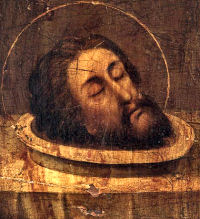
Would you be better off, though?  The face of Herod Antipas, when he is presented with the head of John the Baptist on a platter, is often depicted by artists as being the face of a man facing the horrifying truth that he is now suddenly and entirely alone.

There can be no road now out of the hole he's dug for himself - no one left to shake the branch he's sitting on.


Wednesday, July 08, 2015

The Eighth Sunday after Pentecost                                                     Proper 11 - Year B
Psalm 23

"The Lord is my shepherd, I shall not want."

What is it that we keep around for a rainy day? An awful lot of life's activity consists of collecting resources for ourselves and our families. It's always been that way. If your hobby is metal detecting you live in hope of finding one of those coin hordes which some punter, centuries ago, hid from the taxman in the fourth tree to the left of the bend in the old road.

That the teenager with the metal detector even found the coins meant that the original owner was never able to collect them back in the day. That datum, in itself, should tell you something.

As I was sitting in my office this week looking at Sunday's readings I realized two things; that the 23rd Psalm is very popular (I know at least four different ways of singing it) but that most folks would regard the sort of reliance upon God which the psalm prescribes as being a sign of personal failure on their part.  If you are walking "through the valley of the shadow of death" then you must have taken a wrong turn at Albuquerque. You could be reproached for that. If you are relying on God to lead you "in green pastures" or "beside still waters" or to place a cup in your hands which "floweth over", then where exactly was your brain when you were planning your life? The psalm may be popular but we take it as a big part of our life's work never to be in a place where its precepts and promises become necessary. We strive for self-reliance. We've been told that there's a science to it. With a bit of self-discipline it can be done. We don't need to rely on God.

The Church (at least in the First World and since the Second War) has often played along with this. More's the pity really. A quick side glance at world history will tell us that civilizations rise and fall. We can count ourselves merely lucky to be living where and when we do. Every second page of the New Testament seems to subvert - in parable and pronouncement - the idea that self-reliance is the normal human condition. Where such self-reliance is even possible due to accidents of history and geography, rarely is it pious. Our "great cloud of witnesses" contains all those saints (not to mention the philosophers, the aid-workers, the poets and the musicians and other sundry heroes) who forswore their place on the upward path towards "their piece of the pie" in order to embrace the beauty and the sense of a life that could only be found when uncertainty is sought out and embraced.

What makes us safe and well-equipped does not necessarily make us deep or useful. It cannot ensure that we are good.


Thursday, July 02, 2015

The Sixth Sunday after Pentecost                                                                                
Proper 9 - Year B   
Mark 6:1-13                                                              

"He left that place and came to his hometown...."

What is it about your home town that allows you to blend in so easily when you go back? You're bound to bump into somebody who'll think you've never been away and assumed you'd simply been lying low and keeping to yourself. The pendulum in your head swings back and forth several times between "Yes, this is where I belong"and "No, this is certainly no longer who I am". Some of you have recently been repatriated to the U.S. after a number of years in France. Many of us will return to our home countries for holidays at some point in the summer and will find ourselves reconnected to
family members or old friends. It may prove a challenge.

We should not stretch this passage out of shape by relating it too swiftly to ourselves. This is not a passage about us. This story is about Jesus. The words at the beginning of Mark's Gospel had indicated to the reader that Jesus is one who belongs to God: "You are my beloved Son...", declares the voice from heaven at the Jordan. The townsfolk in Nazareth, though, state that Jesus belongs to them and that he is dead ordinary: "Is not this the carpenter, the son of Mary...". What is more significant here is that they "took offense at him".  Belonging to them meant staying where he had been - nailed into place within the bounds set by elders. Jesus had stepped beyond the life set down for him by his community. God has greater plans that that.

The worthies of Nazareth do not understand what the reader of Mark's Gospel will have understood: In God's hands, the humanity, the origins, the language and culture, the village education and even the intimate family connections of Jesus of Nazareth are a means God will use to move out beyond limits, to move the goal markers, to cross boundaries, to speak truth within a particular religious tradition in order that truth might be spoken within other cultures and religious traditions. Empires are overturned and subverted. The poor are given hope and the captives released. The particularity of Jesus' origins are not discarded even if he breaks the bonds of small town prejudice, even if he moves on, even if he leaves his village behind.

Take no offense at humble origins. God speaks to the world with a Galilean accent.


Thursday, June 25, 2015

The Fifth Sunday after Pentecost                                               
Proper 8 - Year B
2 Corinthians 8:7-15


Paul writes the Corinthian congregation about their involvement with the wider church - in particular the current fundraising project which the outlying churches have undertaken to support the mother Church in Jerusalem. 

"For if the eagerness is there, the gift is acceptable according to what one has—not according to what one does not have."

If-then statements are meant to show how things are tied together.  If you have snow tires then you'll make it to the top of the snowy hill.  If you have a full tank of gas then you will get to Swift Current without gazing nervously at the gas gauge.  If you have the right qualifications then your job application will be received and reviewed.  If-then statements also serve to to provoke self-reflection.  Do you, in fact, have snow tires?  Did you tank up in Saskatoon?  Did you pass your Statistics course at University?  No?  Tough darts then.

Petrol, snow tires and school transcripts are easily quantified.  You have them or you don't.  You can tick the box or not.  Eagerness (and the Greek word here can be translated as zeal, readiness, energy, inclination) is less concrete but completely essential to the task. What Paul seems to be saying here is that it's not just a matter of getting the Quartermaster to do an inventory of what concrete resources
you have at hand but of asking yourself (or your community or your committee)  whether or not you (or they) are interested in doing anything at all.  Do you have that essential ingredient - the presence of which will forgive any number of shortages in concrete resources - which is the good will, the energy, the decision, the inclination and the openness of heart necessary to plug you in to the world around you and to seek after God’s Kingdom?  Yes?  No?

Without mentioning the specific teachings of Jesus anywhere in his Epistles, Paul has all the parables on his side.  The parables are chock full of under-equipped and under-resourced individuals who nonetheless have the following quality:  When they are invited to the banquet they say yes.  When they encounter the treasure in a field they will do what is necessary to make sure it becomes theirs.  They may have nothing but their hunger for righteousness, their inclination towards others, their desire to find meaning in their lives, their willingness to build community and to treasure those bonds with others.  But it's there, that spark.  They can identify it.  They can set their priorities by it.   And if, one day, that energy began to flag then they would themselves know it before anyone took them to task.

“Yes - you're right - I've been a little off recently.”

Do you have what it takes to move forward when energy, conviction and and determination are more important than concrete resources?   If not then what are you going to do about that?  How can we help?